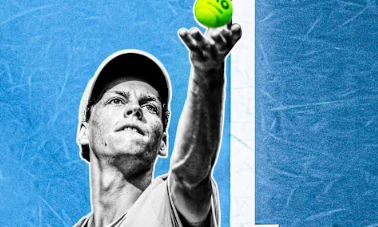
This article was first published on SMH.com.au
Once, only the wealthiest players could afford to crunch the numbers on every opponent’s strengths, weaknesses and habits. Now, with such data widely available, it’s possible for many more to gain a winning edge before even walking onto the court.
Paul McNamee, later a Davis Cup stalwart and Wimbledon doubles champion, tells a story from 1976 when he was in his early 20s and frustrated by his lack of progress. After a chance meeting with Lew Hoad, he poured his heart out to the Australian tennis legend. How could he improve his backhand? Should he be a serve-volley player or a baseliner? Which surface would best suit his game? Hoad listened for a while, then stopped him. “Why are you making it so complicated?” he asked. “Tennis is simple. On the first short ball you go to the net. It doesn’t matter if it’s the second ball in a rally, the fifth or the 50th.” Tennis is simple. Bill Tilden, the US champion of the 1920s and ’30s, thought so, too. Matches, he insisted (ignoring women players altogether), “are won by the man who hits the ball to the right place at the right time most often”. Tennis was simple … until it wasn’t any more.
Welcome to the era of tennis data analytics, where people discuss scientific performance and leveraging technology for optimal player development. It’s the book and film Moneyball, only with more graphs and charts and real-time stats on tablets and laptops at courtside. In February 1926, when Helen Wills played the “Match of the Century” against French star Suzanne Lenglen in Cannes, the young American recited a basic mantra to herself: every shot, every shot, every shot. Simple. Today she would walk on court having been briefed on Lenglen’s stats for pressure points and early breaks converted. Good luck with all that. It’s not only tennis that has gone down this high-tech track. Baseball managers – captured in Moneyball, the Michael Lewis book turned into a Brad Pitt film – were the earliest and most enthusiastic adopters. American football coaches similarly employ technology to a dizzying degree. Basketball, too, has gone bananas, now quantifying not only points and rebounds but also abstruse, seemingly incidental things like deflections. Closer to home, former Australian cricket captain Greg Chappell pondered data from the past 35 years before nominating his preferred openers for the Ashes. He also cited a paper, An Investigation of Synergy Between Batsmen in Opening Partnerships, published in a journal of applied statistics. And look closely whenever TV cameras focus on the coaches’ box during an AFL match: there will be more heads down, peering at screens, than heads up watching the game unfold.
Unsurprisingly, some coaches are more enthusiastic than others about embracing this brave new world. One reason given for the European golfers’ defeat of their American rivals in the Ryder Cup last September was their superior data analysis, which influenced things such as pairings. Europe’s victorious vice-captain Edoardo Molinari – an Italian who earned a degree in engineering before becoming a pro golfer – was lauded for his number-crunching. Tennis Australia has a Molinari. His name is Simon Rea, head of game analysis. He leads a team of six people, with numbers boosted by data-adept casuals over summer. Now 43, Rea, born in New Zealand, was a professional tennis player who then spent time as a coach – for players as different as Sam Stosur, late in her career, and Nick Kyrgios, early in his – but now humbly accepts the title of tennis nerd. His various roles are connected: his coaching was shaped by his experience as a player; now his work with data is all about streamlining and simplifying information to make it useful and digestible for a coach and their charge.
View full article on