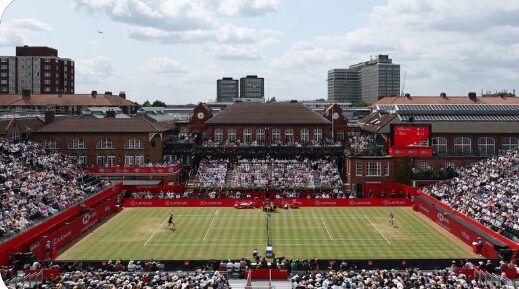
The opening week of the men’s HSBC Championships at Queen’s Club provided a reminder that grass-court tennis remains one of the sport’s most fascinating variables. While the tournament retained its historic prestige and ATP 500 status, the absence of several headline names created an unusually open draw and allowed a broader group of contenders to emerge.
Rather than revolving around a small collection of dominant favourites, the first week evolved into a highly competitive contest featuring established ATP stars, rising talents, experienced grass-court specialists and ambitious outsiders. The result was a tournament rich in tactical variety, surprising outcomes and compelling storylines.
Queen’s has long occupied a unique position within the tennis calendar. Situated just weeks before Wimbledon, it serves both as a prestigious title opportunity and a critical preparation event. Yet the modern tennis landscape has changed significantly. Many elite players now manage their schedules carefully, prioritising peak condition for Grand Slam competition rather than risking injury during the final stages of preparation.
That reality was evident throughout the week. While several leading names participated, the draw lacked some of the sport’s highest-ranked players, creating opportunities for competitors eager to establish themselves as genuine Wimbledon threats.
British hopes centred around Jack Draper, Cameron Norrie, Jacob Fearnley and Arthur Fery. As expected, local support remained one of the defining features of the tournament. The atmosphere inside Queen’s Club frequently elevated key moments, with spectators playing an active role in generating momentum during close encounters.
Among the standout performers, Tommy Paul demonstrated why many analysts regard him as one of the most adaptable players on tour. His movement, court coverage and ability to transition between defensive and offensive positions proved particularly effective on grass. Francisco Cerundolo also impressed, showing that modern baseline players can succeed on grass when they commit fully to aggressive court positioning and early ball striking.
Elsewhere, Alex de Minaur once again displayed the qualities that make him dangerous on any surface. His speed, anticipation and relentless competitiveness allowed him to remain effective even when facing opponents with superior serving power. Brandon Nakashima, Ben Shelton and Gabriel Diallo also generated attention through strong performances and increasingly confident grass-court play.
One of the recurring themes throughout the week was the success of players willing to shorten points. Grass rewards initiative. Competitors who attacked second serves, approached the net and sought to dictate rallies generally enjoyed greater success than those relying purely on defensive consistency.
Several seeded players discovered just how unforgiving the surface can be. Unexpected exits became a feature of the opening rounds, reinforcing the notion that rankings often matter less on grass than on any other surface. Lower-ranked opponents frequently entered matches believing they possessed a realistic chance of victory, and many justified that confidence through bold, proactive tennis.
Service games assumed particular importance. Break opportunities were often limited, placing enormous pressure on players during critical moments. A single lapse in concentration frequently proved decisive. Those capable of protecting their serve consistently gained a significant advantage, while weaker second serves were repeatedly targeted.
The tournament also highlighted how modern grass-court tennis continues to evolve. While powerful serving remains important, success increasingly depends upon a broader collection of skills. Return quality, movement, tactical flexibility and mental resilience all played significant roles during the opening week.
Perhaps most importantly, Queen’s reminded observers that grass remains the great equaliser. The surface compresses differences between players, rewards confidence and creates opportunities for ambitious challengers. Established stars may still enjoy advantages, but they are often smaller than rankings suggest.
As the tournament moved towards its latter stages, several players had positioned themselves as legitimate title contenders. Others may have exited the draw but nevertheless enhanced their prospects for Wimbledon through encouraging performances. For spectators, the opening week delivered exactly what Queen’s has always promised: world-class tennis, strategic intrigue and the possibility of surprise around every corner.