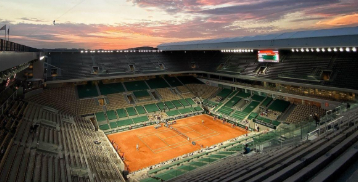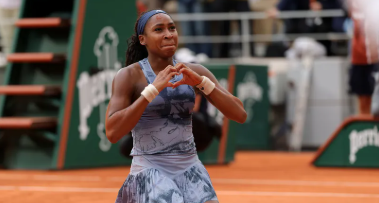
Some players attack the court; Coco Gauff stretches it. That distinction is becoming increasingly important at Roland-Garros, where the geometry of clay tennis often matters more than outright power. Gauff enters Paris carrying the weight of defending champion expectations, but what continues to separate her from many rivals is not simply athleticism. It is the way she manipulates space during pressure exchanges. There are faster players on tour. There are more explosive hitters. There are opponents capable of generating greater isolated power. But very few players in women’s tennis distort court dimensions the way Gauff does.
Her defensive elasticity changes the psychological shape of rallies. Clay amplifies this advantage. The slower surface extends exchanges long enough for Gauff’s movement systems to become increasingly disruptive. Opponents often begin points believing they are in control, only to discover that Gauff’s recovery speed and defensive redirection keep reopening angles that initially looked closed. This creates frustration loops. Aggressive players are gradually forced into hitting closer to the lines. Margins become tighter. Shot selection begins accelerating emotionally. Over time, the pressure reverses direction. That reversal is central to understanding Gauff’s evolution.
Earlier in her career, critics often framed her game primarily through athleticism and defensive ability. Yet the most important development over the past two seasons has been the stabilization of her offensive transitions. Her forehand mechanics appear more structurally reliable under pressure. She is stepping inside the baseline with greater confidence. The balance between defense and controlled aggression has improved significantly. That combination becomes extremely dangerous on clay.
Roland-Garros rarely rewards reckless acceleration over two weeks. The surface gradually favors players capable of sustaining emotional and tactical consistency through repeated pressure cycles. Gauff’s ability to absorb pace while remaining structurally composed makes her uniquely suited to those demands. Her matchup profile against power players is also quietly strong. Against opponents like Aryna Sabalenka or Elena Rybakina, Gauff’s court coverage forces repeated recalibration. Big hitters often thrive when points remain compressed and momentum flows quickly. Gauff disrupts that rhythm by extending exchanges and reintroducing uncertainty.
The longer rallies continue, the more her opponents are forced into difficult emotional calculations. Gauff’s own emotional development has also matured noticeably. There is greater composure between points. Tactical adjustments arrive faster. Momentum swings no longer appear as destabilising as they once did. Importantly, she no longer seems overwhelmed by expectation. That may ultimately matter more than any technical adjustment. Defending a Grand Slam title creates psychological compression that many players struggle to absorb. Every round carries external scrutiny. Every slow start becomes amplified publicly. So far, Gauff appears increasingly comfortable inside that pressure. And in Paris, defensive elasticity often becomes offensive control over time. Few players understand that conversion better than Coco Gauff.