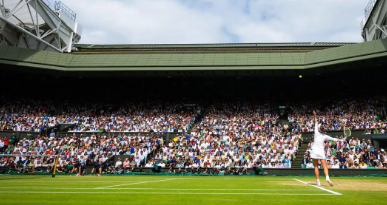
The final scorelines of Wimbledon 2026 are decided. Jannik Sinner defeated Alexander Zverev to win the gentlemen’s singles title. Linda Nosková defeated Karolína Muchová to win the ladies’ singles title. Harri Heliövaara and Henry Patten won the gentlemen’s doubles. Hanyu Guo and Kristina Mladenovic won the ladies’ doubles. Jelena Ostapenko and Marcelo Arévalo won the mixed doubles.
But the competitive meaning of the tournament is considerably more complicated. Wimbledon 2026 was simultaneously a confirmation of hierarchy, a demonstration of depth and a warning against assuming that ranking alone predicts the final weekend.
The gentlemen’s draw was ultimately conventional at the summit. The No. 1 seed met the No. 2 seed in the final. Jannik Sinner defeated Alexander Zverev in four sets, 6-7(7), 7-6(2), 6-3, 6-4. On the surface, this looks like a perfect confirmation of the pre-tournament structure. The top two seeds reached the final. But the tournament’s deeper story was more complex.
Novak Djokovic, the No. 7 seed and seven-time champion, reached the semi-finals before losing to Sinner in straight sets. Arthur Fery, ranked 114th and entering the tournament as a wild card, also reached the final four before losing to Zverev. The final therefore contained the expected No. 1 and No. 2, but the route to that final included both the enduring presence of Djokovic and one of the tournament’s largest ranking breakthroughs.
This is an important distinction. A tournament can produce a conventional final without being a conventional tournament. The men’s draw therefore reinforced the idea that the hierarchy at the top of the sport is increasingly concentrated. Sinner remains the benchmark. Zverev has moved closer to him. Djokovic remains capable of reaching the final stages but faces an increasingly difficult physical and competitive environment. Fery demonstrated that the next layer of the sport remains capable of emerging suddenly.
The women’s draw produced a different competitive pattern. The final was contested by the No. 9 and No. 10 seeds. Nosková defeated Muchová 6-2, 5-7, 6-3 to win her first Grand Slam title.
That ranking profile matters. It does not mean the title was less legitimate. It means that the path through the women’s draw was more volatile than the men’s final outcome suggested. A player did not need to arrive as the No. 1 or No. 2 seed to reach the championship match. Instead, Nosková and Muchová converted their opportunities more effectively than the players ranked above them.
The final statistics reinforce this idea. Nosková won 54.2 per cent of total points. She faced 15 break points and saved 13. Muchová faced 13 break points and saved nine. The champion did not win because she eliminated all danger. She won because she survived more of it.
This is perhaps the most important lesson of the tournament. Grand Slam tennis is not a ranking table. It is a sequential elimination system. Every round changes the probability landscape. One upset changes an entire quarter of the draw. A player who would have faced the No. 2 seed may instead face a lower-ranked opponent. A five-set battle can alter the physical condition of a future opponent. A match-point save can transform one player’s tournament while ending another’s.
The tournament therefore behaves less like a league and more like a cascade, and that is why ranking alone cannot explain Wimbledon. The doubles results make the point even more clearly. The gentlemen’s doubles title went to Harri Heliövaara and Henry Patten, who defeated Marcelo Arévalo and Mate Pavić in straight sets. The pair’s second Wimbledon championship together represented the value of partnership continuity.
The ladies’ doubles title went to Hanyu Guo and Kristina Mladenovic. Their victory combined the emergence of a first-time Grand Slam champion with the experience of a former doubles world No. 1 and multiple major winner. The mixed doubles title went to Ostapenko and Arévalo after a comeback victory over Hunter and Polmans.
Across all three doubles disciplines, a different version of the Wimbledon hierarchy emerged. The most famous singles players were not automatically the dominant doubles players. The strongest individual ranking was not necessarily the most important predictor. Instead, partnership quality, tactical coordination and specialised grass-court instincts became decisive.
That matters because it broadens the meaning of Wimbledon. The Championships are not simply testing who possesses the best individual tennis game. They are testing several forms of elite performance. Sinner’s championship required individual control across a seven-round singles draw. Nosková’s championship required survival and conversion under pressure. Heliövaara and Patten’s required the maintenance of a highly developed partnership system. Guo and Mladenovic’s required the rapid integration of different career experiences. Ostapenko and Arévalo’s required adaptation within a mixed tactical environment.
The tournament therefore revealed that the competitive order is not one-dimensional. There is no single ranking capable of explaining all of Wimbledon. The final week also produced a useful generational contrast.
Djokovic’s semi-final demonstrated that historical greatness remains capable of competing with the modern elite. Sinner’s victory demonstrated that the centre of gravity has nevertheless moved. Zverev’s final demonstrated that the post-Djokovic era is not simply a two-player story. Fery’s semi-final demonstrated that the next breakthrough can emerge from outside the established top tier.
The women’s draw was even more open. Muchová reached her first Wimbledon final. Nosková won her first Grand Slam. Gauff reached the semi-finals before losing a deciding-set tiebreak. Kostyuk reached the last four. The final weekend therefore contained established names, emerging players and a champion whose Grand Slam breakthrough had not been guaranteed by her ranking.
That is the central conclusion of Wimbledon 2026 that the tournament did not show that rankings are irrelevant. It showed that rankings are incomplete. They measure accumulated performance over time. Wimbledon measures performance at a specific place, on a specific surface, under a specific sequence of pressure.
Those are related but different variables as the best player over a season is not necessarily the player who wins a particular tournament. The best grass-court player is not necessarily the player who survives seven rounds of a Grand Slam draw. The strongest doubles partnership is not necessarily composed of the two highest-ranked singles players. Wimbledon remains an elite competition precisely because it compresses so many variables into one fortnight.
Technical quality. Physical condition. Draw volatility. Mental resilience. Surface adaptation. Recovery. Pressure conversion.
At the end of the day, the champion is the player who manages the combined system most successfully.
Tournament Insight
Wimbledon 2026 revealed a competitive order that is simultaneously more concentrated and more volatile. The men’s summit remains dominated by the highest-ranked players, with Sinner and Zverev meeting in the final. The women’s draw demonstrated greater movement between ranking and outcome, producing an all-Czech final between Nosková and Muchová. The doubles competitions reinforced the importance of specialised partnership systems. The broader conclusion is clear: rankings remain useful predictors, but Grand Slam tennis is increasingly decided by the interaction between ranking, surface, draw structure, pressure and adaptation.