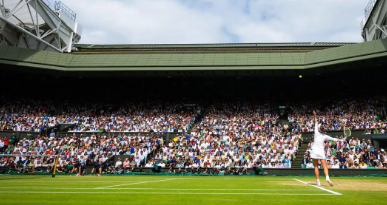
The second week of Wimbledon has reached the stage where every point carries greater consequence. The opening rounds established the contenders, while the fourth round confirmed who possessed the consistency, tactical discipline and physical resilience to remain in the hunt for one of tennis’ most prestigious titles. With the quarter-finals now underway, both the gentlemen’s and ladies’ draws have produced fascinating storylines that promise an outstanding finish to The Championships.
On the men’s side, defending champion and world No. 1 Jannik Sinner has continued to justify his status as the player to beat. Throughout the tournament, the Italian has combined powerful baseline tennis with remarkable composure, rarely allowing opponents to dictate the tempo of matches. His quarter-final victory over Jan-Lennard Struff illustrated exactly why he remains such a formidable competitor. Struff’s aggressive serving and fearless attacking tennis had carried him to the last eight, becoming one of the tournament’s feel-good stories, but Sinner absorbed the pressure, survived a tense second-set tiebreak and advanced in straight sets to book another Grand Slam semi-final appearance.
Novak Djokovic continued his pursuit of yet another Wimbledon crown, setting up another compelling battle against Felix Auger-Aliassime. The Serbian’s experience remains invaluable during the latter stages of Grand Slams, where momentum can change quickly and every service game becomes increasingly important. Auger-Aliassime, meanwhile, has quietly produced some of his best grass-court tennis, using his explosive serve and forehand to earn another deserved place among the tournament’s elite. Their encounter represents a fascinating contrast between proven championship pedigree and a player determined to break through on one of tennis’ biggest stages.
The remaining quarter-finals are equally intriguing. Alexander Zverev’s continued improvement on grass has earned him another opportunity to challenge for a maiden Wimbledon title, while Taylor Fritz has once again demonstrated why many regard him as one of the ATP Tour’s finest grass-court performers outside the traditional favourites. Fritz’s serve has remained one of the tournament’s most reliable weapons, conserving both physical and mental energy during crucial moments.
Perhaps the biggest surprise among the final eight has been Flavio Cobolli. After an outstanding clay-court season, many questioned whether the Italian could transfer that form onto grass. He has answered emphatically. His straight-sets victory over Alex de Minaur highlighted not only his powerful baseline game but also his growing confidence on faster courts. Cobolli now stands among the tournament’s genuine breakthrough performers and continues to play with the freedom that often accompanies players enjoying career-best Grand Slam runs.
Britain’s hopes ultimately came to rest with Arthur Fery, whose remarkable Wimbledon has captivated home supporters. Fery’s progression into the quarter-finals represents one of the stories of the tournament, demonstrating both composure and resilience under enormous public expectation. Regardless of how far he progresses, his performances have provided British tennis with another encouraging sign for the future.
The women’s tournament has arguably produced even greater intrigue. Coco Gauff finally achieved a long-awaited breakthrough at Wimbledon by reaching her first semi-final after recovering brilliantly to defeat fellow American Jessica Pegula. Having burst onto the scene as a teenager at the All England Club, Gauff has steadily matured into one of the world’s most complete competitors. Her comeback victory once again highlighted the improved tactical patience that now complements her outstanding athleticism.
Karolína Muchová also continued her impressive run, overcoming Naomi Osaka in a contest that showcased two players capable of producing sublime all-court tennis. Muchová’s elegant variety, intelligent shot selection and ability to change pace repeatedly disrupted Osaka’s rhythm, earning the Czech another deserved place in the final four. Osaka’s return to the latter stages of Grand Slam competition nevertheless remains one of the tournament’s encouraging stories and suggests that she is steadily rebuilding the consistency that once made her one of the game’s dominant forces.
Elsewhere, Linda Nosková has continued to emerge as one of the tournament’s rising stars after upsetting Madison Keys to reach her maiden Wimbledon quarter-final. Marta Kostyuk has also enjoyed a breakthrough campaign, combining aggressive baseline tennis with impressive mental discipline, while Elise Mertens’ consistency has earned her another deep run at a major championship. Jasmine Paolini, meanwhile, ended Alexandra Eala’s inspiring campaign to secure her own quarter-final place, ensuring that the women’s draw remains refreshingly diverse in both playing styles and national representation.
The doubles competitions have likewise intensified. Established partnerships have begun to demonstrate the chemistry and instinctive positioning that often separate specialist doubles teams from improvised pairings. Quick reflexes at the net, effective serving patterns and coordinated movement continue to prove decisive on grass, where opportunities can disappear within a single exchange.
Off the court, Wimbledon continues to strike its familiar balance between heritage and innovation. The introduction of video review technology alongside the now-established electronic line calling system has modernised officiating without detracting from the traditions that define the Championships. Spectators continue to enjoy one of the sport’s most distinctive atmospheres, where appreciation for tactical excellence is often every bit as enthusiastic as admiration for spectacular winners.
With Championship Weekend now firmly in sight, the tournament has reached the stage where marginal gains become decisive. Technical ability alone is no longer enough. Recovery, emotional control, efficient serving and intelligent scheduling all become increasingly influential as the physical demands of seven potential matches begin to accumulate. The field may now be smaller, but the quality has never been higher.
Tournament Insight
As Wimbledon approaches its final stages, one trend has become increasingly apparent: efficiency is proving more valuable than dominance. The players still competing have generally avoided marathon encounters, protected their service games and adapted intelligently to changing opponents. In modern Grand Slam tennis, conserving energy can be every bit as important as producing spectacular highlights, and the eventual champion is increasingly likely to be the player who has managed both better than everyone else.