The arrival of the fourth round always signals a shift in atmosphere at Wimbledon. The opening week is about survival, settling into the unique rhythm of grass-court tennis and avoiding the unexpected upset. The second week, however, is where genuine title ambitions begin to take shape. Every remaining player has already demonstrated quality, but only those capable of raising their level further will continue the journey towards Centre Court on Championship Weekend.
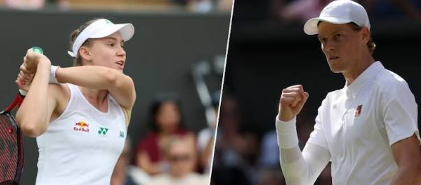
On the men’s side, world No. 1 Jannik Sinner continued to underline why he entered Wimbledon as one of the tournament favourites. His route into the latter stages has been characterised by remarkable efficiency rather than spectacular drama. Sinner has consistently protected his serve, controlled rallies with penetrating groundstrokes and displayed a maturity that has become increasingly evident throughout the past two seasons. Even when opponents have attempted to disrupt his rhythm through aggressive net play or variation, he has remained composed, rarely allowing momentum to swing dramatically.
Novak Djokovic once again demonstrated why writing him off at Wimbledon remains a dangerous mistake. While younger rivals may possess greater physical explosiveness, few players can match the Serbian’s understanding of the grass-court game. His anticipation, defensive positioning and ability to construct points continue to frustrate opponents who often find themselves forced into taking increasingly difficult risks. Another appearance in the latter stages would surprise nobody.
Alexander Zverev continued to progress confidently, serving with authority while showing greater willingness to finish points inside the forecourt. The German’s improved tactical flexibility has become one of the strongest features of his game, particularly on faster surfaces where shorter rallies are often rewarded.
Taylor Fritz strengthened his reputation as one of the ATP Tour’s elite grass-court competitors. His serve remained one of the tournament’s biggest weapons, frequently earning straightforward service holds that conserve valuable energy for the physically demanding second week. Alongside him, Alex de Minaur continued to showcase perhaps the most significant transformation among the world’s leading players. Once considered primarily a defensive retriever, the Australian now combines relentless movement with genuine attacking intent, making him a dangerous opponent regardless of surface.
Daniil Medvedev has also quietly assembled another impressive campaign. His unusual positioning continues to unsettle opponents unfamiliar with his tactical patterns, while his ability to absorb pace before redirecting it has translated surprisingly well to grass. Every additional round reinforces the Russian’s growing confidence on a surface that once appeared ill-suited to his game.
Several other names remain firmly in contention. Alexander Bublik has balanced his trademark creativity with noticeably greater discipline, producing enough consistency to complement his spectacular shot-making. Hubert Hurkacz continues to demonstrate why his serve-and-first-strike approach remains ideally suited to Wimbledon, while Matteo Berrettini’s heavy forehand continues to produce some of the most explosive winners of the tournament. Flavio Cobolli, Grigor Dimitrov, Arthur Rinderknech and Jan-Lennard Struff have each contributed impressive performances that underline the remarkable depth now present across the ATP Tour.
British attention remained focused on Jack Draper, whose combination of power, confidence and growing maturity has generated genuine optimism among home supporters. Playing under expectation at Wimbledon has challenged many British players over the decades, yet Draper appears increasingly comfortable embracing rather than avoiding that pressure. His aggressive style has consistently suited the grass courts, while his physical durability has allowed him to maintain intensity throughout demanding encounters.
The women’s draw has continued to provide outstanding quality alongside considerable unpredictability. Aryna Sabalenka has looked increasingly formidable with each passing round. Her ability to dominate behind the first serve has been matched by improved point construction and better shot selection, allowing her to avoid many of the unnecessary errors that occasionally interrupted earlier campaigns.
Iga Świątek has continued to answer long-standing questions regarding her ability on grass. While clay remains her strongest surface, her movement, serving patterns and willingness to attack shorter balls have all improved significantly. The confidence gained from recent seasons is becoming increasingly visible, making her a legitimate contender to add Wimbledon to her growing collection of Grand Slam titles.
Elena Rybakina once again appeared exceptionally comfortable on the lawns of the All England Club. Her effortless timing and naturally flat ball-striking allow her to generate consistent pressure without sacrificing control. Few players look more technically suited to grass, and her calm temperament remains one of her greatest competitive strengths.
Coco Gauff has continued her impressive development into one of the WTA Tour’s most complete competitors. Her athleticism has always been among the very best in women’s tennis, but the steady improvement of her serve and tactical decision-making has transformed her into a genuine threat on every surface. Jessica Pegula has again relied upon consistency and intelligent court positioning to remain firmly in contention, while Mirra Andreeva continues to impress with maturity that far exceeds her years.
Elsewhere, Naomi Osaka has continued her encouraging resurgence, Belinda Bencic has rediscovered much of her creative all-court tennis, and players including Karolína Muchová, Marta Kostyuk, Linda Nosková, Elise Mertens, Emma Navarro, Diana Shnaider, Ekaterina Alexandrova and Jelena Ostapenko have ensured the women’s competition remains remarkably open.
The doubles events have also entered a fascinating stage. Experienced partnerships have begun asserting themselves through superior communication and tactical understanding, although several emerging pairings continue to demonstrate that aggressive returning and instinctive net play can quickly neutralise differences in experience. As always, Wimbledon remains one of the finest showcases for doubles specialists, where grass rewards decisive teamwork and quick reactions.
With the quarter-finals now within touching distance, every match carries increasing significance. The physical demands accumulated during the opening week are beginning to influence recovery schedules, while tactical adjustments become more refined as players face opponents capable of exposing even minor weaknesses. The margin for error continues to shrink.
Tournament Insight
The fourth round represents more than a numerical milestone. It marks the point where Wimbledon transforms from a tournament of possibilities into one of probabilities. The remaining players possess not only the technical quality to win matches but also the physical resilience, tactical flexibility and emotional discipline required to survive a Grand Slam’s closing stages. From this point forward, championships are often decided not by spectacular moments alone, but by consistency across every aspect of performance.