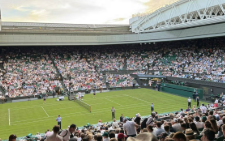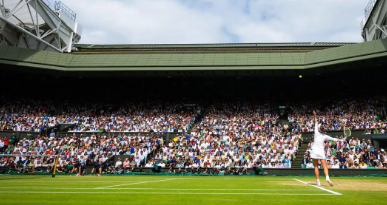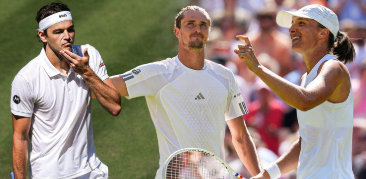
The opening week of Wimbledon once again demonstrated why the All England Club remains one of the sport’s greatest examinations. Grass rewards confidence but punishes hesitation, producing a unique blend of explosive shot-making, tactical discipline and mental resilience. As the tournament moved through its opening rounds, established champions reaffirmed their credentials, emerging talents continued their rapid ascent and several highly fancied names found themselves leaving London far earlier than expected.
On the men’s side, world No. 1 Jannik Sinner entered the Championships carrying the weight of expectation after another outstanding season. Rather than being distracted by that status, the Italian settled quickly into the rhythm of grass-court tennis, displaying the clean ball-striking and calm court management that have become his trademark. His ability to shorten rallies while remaining composed in extended exchanges suggested a player entirely comfortable with the unique demands of Wimbledon.
Novak Djokovic once again reminded everyone why he continues to be one of the most dangerous competitors on Centre Court regardless of age or ranking. His movement across the slick surface, anticipation and ability to absorb pressure remained exceptional. While younger rivals continue to close the physical gap, Djokovic’s experience on grass remains arguably unmatched in the modern era, allowing him to negotiate difficult moments without unnecessary drama.
Alexander Zverev also opened strongly, continuing to demonstrate the improvements that have made him one of the ATP Tour’s most consistent performers over the past eighteen months. His serve remained a major weapon, but equally impressive was his willingness to finish points at the net rather than relying exclusively on baseline exchanges.
Taylor Fritz arrived as one of the leading grass-court specialists outside the traditional favourites. The American’s powerful first serve, flat groundstrokes and comfort on faster surfaces once again translated effectively onto the Wimbledon lawns. Alongside him, Alex de Minaur continued to prove that relentless court coverage can be just as valuable as outright power. The Australian’s improved offensive instincts have transformed him from a counter-puncher into a genuine contender capable of troubling any opponent.
Daniil Medvedev, despite grass never being considered his ideal surface early in his career, continued to demonstrate how successfully he has adapted his game. His unconventional positioning and exceptional defensive instincts remained difficult for opponents to solve, while his serve frequently provided free points during critical moments.
Elsewhere, several dangerous outsiders quietly built momentum. Alexander Bublik once again showcased his unpredictable variety, mixing booming serves with delicate drop shots and fearless improvisation. Hubert Hurkacz continued to display the qualities that make him one of the Tour’s most naturally suited grass-court players, while Matteo Berrettini reminded observers of the formidable weapons that have previously taken him deep into Wimbledon.
British hopes naturally attracted enormous attention. Jack Draper entered the Championships carrying increasing expectations following his rise through the rankings. Backed by enthusiastic home support, he displayed the aggressive style that has established him among the ATP’s emerging elite. Cameron Norrie and Jacob Fearnley also attracted significant interest, with British fans enjoying another encouraging week of domestic representation.
The women’s draw proved equally compelling. Aryna Sabalenka entered Wimbledon among the leading favourites and immediately demonstrated why her combination of power and improved tactical patience makes her exceptionally dangerous on grass. Her first serve consistently placed opponents under immediate pressure, while her movement around the baseline looked more controlled than in previous seasons.
Iga Świątek continued her ongoing evolution on grass. Once regarded primarily as a clay-court specialist, the Pole has steadily developed a more versatile game, using improved serving patterns and greater willingness to attack shorter balls. Wimbledon has traditionally posed different questions for her than Roland Garros, yet her progress suggested increasing comfort on the surface.
Elena Rybakina once again appeared entirely at home on grass. The former champion’s effortless power, economical movement and remarkably clean timing allowed her to dictate rallies with minimal risk. Few players generate pace as naturally as the Kazakh, making her one of the tournament’s most feared competitors.
Coco Gauff continued to mature as one of the WTA Tour’s leading figures. While her athleticism has never been questioned, her tactical development has become increasingly apparent. Improved serving consistency and greater confidence in finishing points have made her a considerably more complete grass-court player than in previous seasons.
Jessica Pegula’s calm efficiency again proved effective during the opening rounds, while Mirra Andreeva continued to justify the enormous excitement surrounding her future. The young Russian’s composure against experienced opponents highlighted maturity well beyond her years.
Elsewhere, Naomi Osaka continued her encouraging return to Grand Slam competition, Belinda Bencic rediscovered much of the confident all-court tennis that once placed her among the elite, and Marta Kostyuk, Karolína Muchová, Linda Nosková, Elise Mertens and Jelena Ostapenko all demonstrated why the women’s field remains one of the deepest in recent memory.
The doubles competitions also began at a high standard, with established partnerships and emerging combinations producing several tightly contested encounters that reinforced Wimbledon as one of the sport’s premier stages across every discipline.
The opening week ultimately reinforced one recurring truth about Wimbledon. Rankings establish expectations, but grass often rewrites them. The narrow margins, low bounce and premium placed on first-strike tennis continue to reward adaptability as much as outright talent. As the Championships moved towards the second week, the list of genuine contenders remained impressively broad, promising an increasingly compelling battle for one of tennis’ most prestigious titles.
Tournament Insight
Week One suggested that the modern Wimbledon champion is no longer defined solely by a dominant serve or aggressive forehand. Instead, success increasingly belongs to players capable of blending power with adaptability, disciplined shot selection and efficient movement. Those who expended the least physical and emotional energy during the opening rounds may ultimately hold the greatest advantage as the tournament enters its decisive stages.