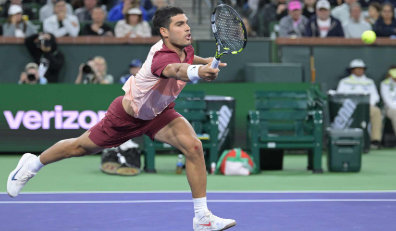
Carlos Alcaraz’s loss to Sebastian Korda in Miami was not driven by lack of aggression, but by failure to control the second strike in rallies. Alcaraz typically builds points through explosive first-strike patterns followed by rapid court coverage. Against Korda, that sequence was disrupted. Korda’s baseline positioning remained consistently deep, forcing Alcaraz to generate additional pace rather than redirecting existing momentum. This shifted rallies from controlled acceleration to forced construction. As rallies extended, Alcaraz’s shot tolerance dropped, particularly on backhand exchanges where he attempted to force direction changes prematurely.
The critical phase came in mid-set exchanges where Korda absorbed pressure and extended points beyond five shots. Alcaraz’s error rate increased not due to poor technique, but due to overcommitment in neutral positions. Instead of resetting, he attempted to finish points early. Korda’s performance was structurally simple: maintain depth, avoid overextension, and force Alcaraz into repeated decision cycles. The result was a gradual erosion of Alcaraz’s control rather than a direct tactical defeat.