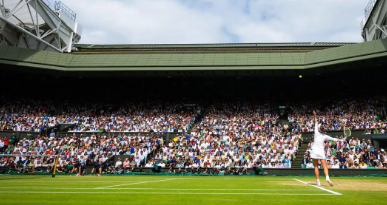
The return of women’s tennis to Queen’s Club continued to gather momentum during the opening week of the HSBC Championships, delivering a fascinating blend of established stars, emerging contenders, local favourites and unexpected results. While much of the attention before the tournament centred on a handful of leading names, the early rounds quickly demonstrated why grass remains one of the most unpredictable surfaces in professional tennis.
Unlike clay, where extended rallies often reward patience and consistency, or hard courts where athleticism can gradually wear down opponents, grass places a premium on timing, confidence and execution. The opening week repeatedly showcased how quickly momentum can shift and how narrow the margins between victory and defeat become when points are shorter and opportunities more limited.
British interest remained particularly strong throughout the week. Emma Raducanu, Katie Boulter, Sonay Kartal, Heather Watson and Jodie Burrage all attracted significant support from local spectators eager to see home players perform well on one of the country’s most historic courts. The atmosphere generated by the crowd frequently added another dimension to matches, particularly during tight service games and deciding sets.
Several top seeds arrived at Queen’s seeking momentum ahead of Wimbledon. Players such as Zheng Qinwen, Madison Keys, Elena Rybakina and Karolina Muchova entered the event carrying expectations, but grass has always possessed a unique ability to disrupt conventional rankings. The quicker surface often rewards aggressive ball strikers and proactive players regardless of their ranking position.
One of the most compelling themes of the opening week was the emergence of players whose games naturally complement grass-court tennis. Flat hitters capable of taking the ball early repeatedly troubled higher-ranked opponents. Strong servers gained additional rewards from the surface, while players willing to attack the net found opportunities to shorten rallies and place opponents under pressure.
Donna Vekic was among those who demonstrated the value of experience and tactical clarity on grass. Her ability to strike through the court efficiently and maintain composure during key moments made her one of the standout performers of the week. Similarly, several lower-ranked competitors used the conditions to showcase strengths that may be less effective on slower surfaces.
The tournament also highlighted the increasing depth within the women’s game. Rather than being dominated by a small collection of favourites, Queen’s produced a wide range of competitive matches involving players from across the rankings. Numerous contests were decided by only a handful of points, emphasising the importance of concentration and tactical decision-making.
Several unexpected exits reminded observers that reputation alone carries little weight on grass. Early casualties among seeded players created opportunities for outsiders, while qualifiers and lower-ranked competitors seized chances to make deep runs. The compressed nature of grass-court tennis often narrows the gap between elite contenders and ambitious challengers.
Another notable aspect of the week was the quality of movement displayed by successful players. Contrary to the traditional belief that grass is purely a serving surface, many victories were built upon efficient footwork, intelligent court positioning and the ability to transition quickly between defence and attack. Players who adapted most effectively to the lower bounce consistently enjoyed greater success.
The opening rounds also provided valuable insight into Wimbledon preparation. Several competitors appeared focused not only on immediate results but also on refining aspects of their game ahead of the sport’s most prestigious championship. Tactical experimentation, net approaches and aggressive return positioning were all evident throughout the week.
As Queen’s progressed towards its decisive stages, the tournament remained remarkably open. A number of contenders had established themselves as genuine title threats, while others enhanced their reputations through resilient performances and impressive victories over higher-ranked opponents.
The opening week ultimately reinforced one of tennis’ most enduring truths. Grass rewards courage. Players willing to trust their instincts, embrace risk and execute decisively often find themselves thriving. Queen’s once again delivered compelling evidence that on this surface, opportunity belongs to those prepared to seize it.